Shoptalk Spring 2026 made one thing very clear: eCommerce has entered a new phase where AI is no longer a side conversation. It is now part of the core retail agenda. The event itself leaned hard into that direction, positioning this year around “Retail in the Age of AI,” with a program focused on next-generation shopping experiences, site search and discovery, unified commerce, retail media measurement, loyalty, and the practical implications of AI for retail operators. Shoptalk says the event brought together more than 10,000 attendees and 180+ speakers in Las Vegas.
That macro picture matters.
But after the event, the more useful question is not just what was said on stage. It is what kept showing up in real conversations with merchants, operators, and eCommerce leaders.
And when you combine the official themes with what brands are actually dealing with on the ground, a clear pattern emerges: the market is thinking a lot about AI, but many businesses are still being held back by much more immediate execution problems.
That, in our view, was the real story of Shoptalk Spring 2026.
What Shoptalk 2026 itself emphasized
The official agenda was a strong signal of where the market’s attention has moved.
Shoptalk’s 2026 program included sessions on AI agents, site search and discovery, unified commerce, loyalty, and retail media measurement, all framed around practical application. The messaging was not just “AI is coming.” It was closer to “AI is already reshaping customer journeys, and retailers need to respond operationally.” That same theme showed up in post-event recaps from firms like PwC, which described Shoptalk 2026 as a reflection of how AI is moving from experimentation toward implementation in commerce.
That is an important distinction.
A year or two ago, a lot of conference discussion around AI still felt exploratory. At Shoptalk Spring 2026, the tone was noticeably more practical:
- How is discovery changing?
- What happens when search becomes more answer-driven?
- How do brands make themselves visible inside AI-assisted experiences?
- How should teams think about loyalty, measurement, and customer experience in this new environment?
Those are operational questions.
The most important insight was not about AI alone
Across our meetings at Shoptalk, one pattern came up again and again: most brands are not suffering from a lack of ideas. They are suffering from a lack of execution speed.
That was true across different kinds of businesses:
- mid-market brands
- larger merchants
- teams with internal resources
- teams supported by agencies or freelancers
In conversation after conversation, the blockers were surprisingly familiar:
- improvements taking too long to implement
- overloaded internal teams
- unreliable external execution
- platform or architecture choices creating unnecessary drag
- obvious on-site UX and CRO issues still unresolved
This was striking because it sat in direct contrast with the broader conference narrative.
The market is talking about AI, discovery, and the future of commerce.
But a lot of businesses are still losing revenue through very basic operational and customer-experience problems.
The gap between strategy and execution is still visible.
Product discovery is changing, but SEO is still foundational
One of the most important themes coming out of the event was how product discovery is evolving.
That was visible in the Shoptalk agenda itself, especially in sessions focused on next-generation shopping experiences and the redefinition of site search and discovery. It also lines up with what is happening more broadly in the market: traditional search is still dominant, but discovery behavior is clearly starting to fragment.

Google still accounted for 89.85% of global search engine market share in March 2026, which means traditional search remains the main discovery channel for most brands. At the same time, McKinsey reported in late 2025 that half of consumers already use AI-powered search, and that AI-led discovery could influence a very meaningful share of consumer spend over the next few years.
That is exactly why the current conversation around GEO/AEO matters.
Customers are increasingly researching products in more than one place:
- classic search
- AI-assisted search
- LLMs and conversational tools
- marketplaces
- social platforms
- platform-native search environments
In practical terms, that means ranking blue links isn’t enough for brand visibility. The deciding factor today is whether your products, categories, content, and brand signals can be interpreted, surfaced and recommended in answer-driven environments.
Why GEO/AEO matters, and why it does not replace SEO
A lot of merchants are asking the same question now: Do we need to rethink SEO entirely because of AI?
The answer is more nuanced.
SEO remains the foundation. GEO/AEO is becoming the next layer on top of it.
Google’s own guidance is consistent here. Its recommendations for “helpful, reliable, people-first content” still apply, and Google explicitly says the same core best practices are relevant for AI features like AI Overviews and AI Mode. On the eCommerce side, Google also continues to emphasize structured data for products, offers, pricing, availability, shipping, and related information to help search engines understand and present commercial pages more effectively.

That means a lot of what brands already do for strong SEO still helps with AI-driven discovery:
- clear site architecture
- useful content
- well-structured categories
- strong PDPs
- accurate product data
- internal linking
- technical crawlability
- structured data
- mobile usability
But GEO/AEO usually requires additional work too.
In our view, the areas that increasingly need explicit attention are:
- comparison-oriented content
- clearer answer-first content structure
- stronger product attribute clarity
- tighter brand/entity consistency
- broader discoverability beyond owned pages
- better content that helps machines understand not just what you sell, but when, why, and for whom it is relevant
That final point is becoming especially important because AI-assisted search does not rely only on your own site. McKinsey noted that AI search experiences often pull from a broader mix of sources, which means your visibility increasingly depends on your wider digital footprint as well.
AI traffic is still smaller, but often higher-intent
Another theme worth taking seriously is the quality of AI-driven traffic.
Adobe reported that during the 2025 holiday season, traffic from AI sources to retail sites rose 693% year over year. It also reported continued growth into early 2026, including 393% year-over-year growth in AI traffic to U.S. retail sites in Q1 2026. Adobe’s reporting also suggests that AI-referred visitors are often highly engaged and, in some periods, more likely to convert than non-AI traffic.

This fits what many merchants are beginning to observe.
AI traffic is not yet the main traffic source for most stores.
But it often behaves differently.
Why? Because many of those visitors are not arriving at the very beginning of the journey. They are arriving after using AI tools to:
- compare products
- understand trade-offs
- shortlist options
- evaluate categories
- narrow down choices
That typically means stronger intent. And that changes the role of the site.
For more and more merchants, the website is no longer a tool for attracting discovery. It’s not validating, reassuring, differentiating, and converting a visitor who may already be partly informed before they arrive.
That makes PDP quality, trust signals, reviews, shipping clarity, returns clarity, comparison content, and merchandising even more important than before.
The market’s biggest problem is still execution
If there was one pattern that stood out most strongly in our conversations, it was this: the market does not have an idea problem. It has an execution problem.
This came up repeatedly:
- agencies moving too slowly
- freelancers being hard to rely on
- internal teams already at capacity
- long backlogs for relatively simple changes
- merchants knowing what needs to be fixed, but being unable to move quickly enough
That is why speed of execution is becoming one of the most underestimated advantages in eCommerce.
A lot of brands already know their priorities.
They know they need to improve product discovery, clean up UX, strengthen lifecycle marketing, improve mobile performance. refine messaging. fix conversion friction, and simplify operations.
The real issue is that too many organizations still cannot do those things fast enough, which becomes a growth issue.
Headless is still valid, but many teams are questioning the trade-off
Another recurring theme was frustration with complexity.
Headless commerce still has valid use cases. For the right business, it can be the right choice.
But many teams are now taking a harder look at the trade-off:
- simple changes requiring developer input
- marketing teams losing autonomy
- slower iteration cycles
- more maintenance than expected
- performance gains not always justifying the complexity
That is leading to a more mature question than “Can we go headless?”
The better question is:
Does this architecture create enough business value to justify the complexity it adds?
That question is especially important in a market where speed, adaptability, and efficient execution are becoming more valuable.
For some brands, headless absolutely supports those goals. For others, it creates permanent friction.
CRO is still one of the biggest missed opportunities in eCommerce
This was probably the most practical insight from our conversations.
Even brands doing serious revenue often still showed clear opportunities in:
- product discovery
- mobile UX
- PDP clarity
- CTA visibility
- category structure
- merchandising logic
- upsell and cross-sell presentation
- trust and conversion support
In other words, while the industry is increasingly focused on AI, a lot of revenue is still leaking through very familiar on-site issues.
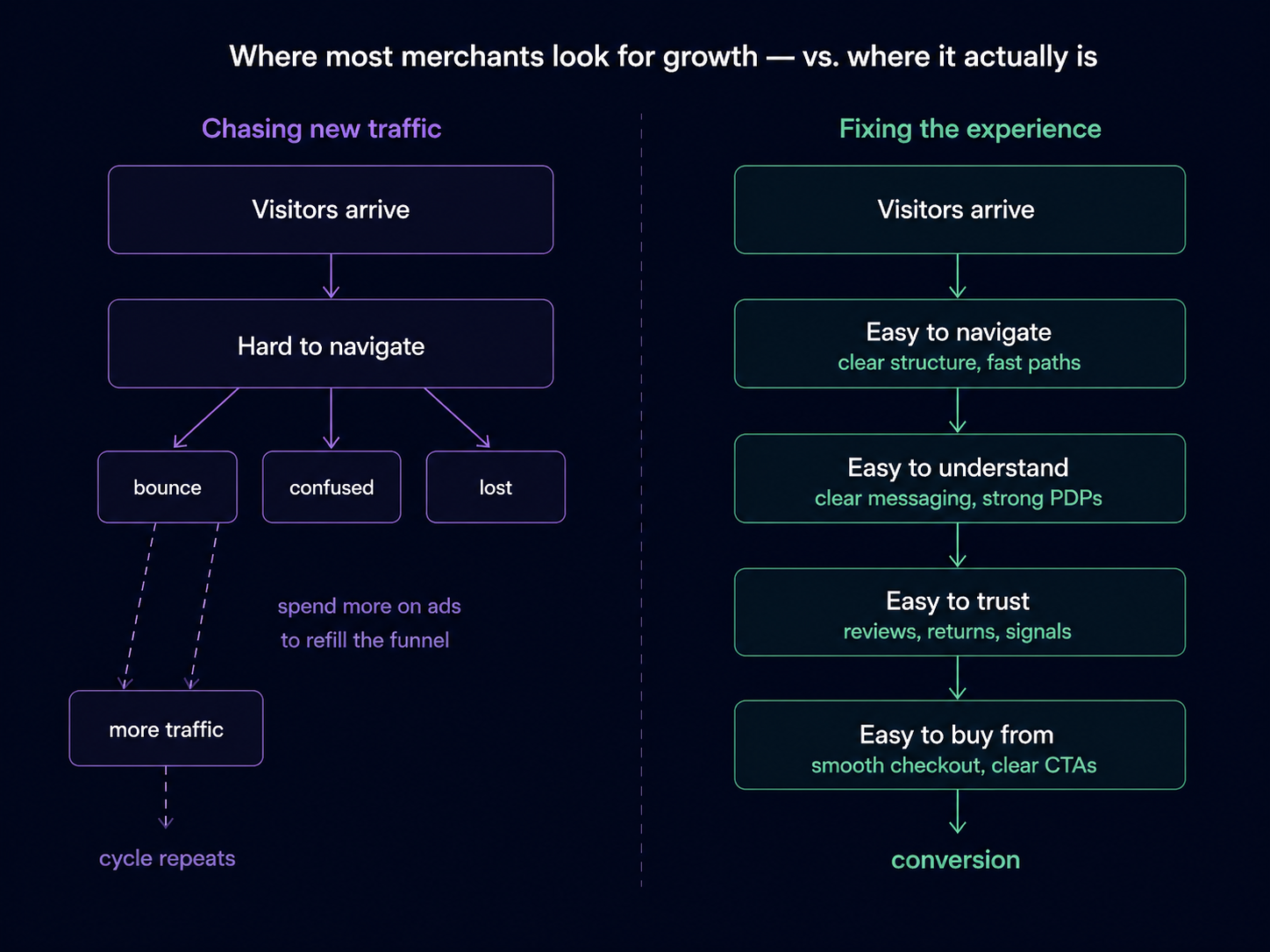
That matters because the fastest path to growth is not always a major transformation project.
Very often, it is a sequence of practical improvements that make the site:
- easier to navigate
- easier to understand
- easier to trust
- easier to buy from
This is where CRO remains massively underused.
A lot of merchants still look for growth primarily through new traffic channels, when the bigger short-term opportunity may be fixing the experience that current traffic lands on.
Shopify migration momentum is real, and the conversation is changing
Another clear pattern from Shoptalk was how many brands were either:
- recently migrated to Shopify
- actively evaluating Shopify
- considering a move from Magento, WooCommerce, BigCommerce, or custom setups
That does not mean Shopify is right for every business.
But it does mean the terms of the platform discussion are changing.
Historically, many platform conversations revolved around feature sets and theoretical flexibility.
Now, the more important question is often much simpler:
Which platform helps the business move faster, operate more efficiently, and reduce unnecessary complexity?
That is a very different lens.
And for many mid-market brands, it is becoming the most important one.
Magento and custom platforms can still offer deep flexibility. WooCommerce can still be the right fit in some cases. BigCommerce still has its place.
But more and more merchants are asking whether those setups help them:
- launch faster
- iterate faster
- support internal teams more easily
- reduce development dependency
- improve total operating efficiency
When that becomes the main decision framework, Shopify naturally enters more conversations.
Because speed of execution, operational simplicity, and ease of change have become more strategic than many businesses used to admit.
Loyalty is becoming more emotional, not just transactional
Shoptalk’s official agenda also put real focus on loyalty, including the distinction between transactional and emotional loyalty. That is an important framing. Retailers are clearly being pushed to think beyond discounts and reward mechanics alone, and to build stronger customer relationships through brand, relevance, community, and personalized experience.
That matters because in a noisier, more fragmented discovery environment, loyalty is no longer just about incentives.
It is about trust, relevance, consistency, clarity, post-purchase experience, emotional preference, and overall ease of buying.
The brands that build stronger retention over the next few years will likely be the ones that connect those pieces well.
A loyalty program by itself is not enough. Loyalty is often the output of:
- better customer journeys
- clearer product communication
- stronger post-purchase flows
- more relevant lifecycle marketing
- fewer friction points across the experience
-
What Shoptalk Spring 2026 means for merchants right now
If we combine the official conference themes with what we saw in merchant conversations, the most useful conclusions are these.
1. AI is moving into the operating model
The market has moved beyond “Should we care?” and into “How do we apply this?”
2. Product discovery is broadening
Google still dominates, but AI-assisted research is becoming more relevant in how customers evaluate and compare products.
3. SEO is still essential
The fundamentals still matter, and many of them also support GEO/AEO.
4. AI traffic is increasingly worth paying attention to
Even if the traffic share is still smaller, the intent quality can be strong.
5. Execution speed is one of the biggest hidden growth levers
The businesses that move faster will have a real advantage.
6. Complexity is being re-evaluated
Architecture and platform choices are being judged more directly on business impact.
7. CRO remains one of the highest-ROI opportunities
Many merchants are still leaving very fixable revenue gains on the table.
8. Platform decisions are increasingly about velocity
Merchants are asking which setup reduces drag and enables better execution.

Final takeaway
If there was one big lesson from Shoptalk Spring 2026, it was this: the future of commerce is arriving quickly, but most brands still have major upside in fixing the fundamentals.
AI-driven discovery is real. GEO/AEO is becoming more relevant. Search behavior is changing. Platform decisions are being rethought. Loyalty is evolving. Measurement expectations are rising. But right now, many businesses still have immediate opportunities sitting in plain sight – better product discovery, stronger PDPs, cleaner UX, faster implementation, simpler operations, smarter platform choices, and clearer conversion paths.
The brands that win the next phase will combine innovation with operational clarity and the ability to execute fast.
How Axceleris can help
At Axceleris, we help mid-market eCommerce brands turn these kinds of insights into execution.
That includes:
- Shopify and Shopify Plus builds
- Magento and Adobe Commerce support
- replatforming strategy
- CRO and UX improvement
- SEO and AI-discovery readiness
- technical performance optimization
- growth-focused audits that identify where revenue is being lost and what to fix first
If your team is considering a move to Shopify, stuck with a slow or overcomplicated setup, seeing traffic but not enough conversion, trying to improve SEO while preparing for AI-driven discover or looking for clearer growth priorities after a redesign, migration, or expansion, we can help you identify the highest-impact next steps.
Want us to take a look at your store?
We can run an expert-led audit of your customer journey, platform setup, CRO opportunities, SEO foundations, and AI-discovery readiness – and show you where the biggest growth opportunities are.

Recent articles